

Personal injury law firms are no longer just managing cases. They are managing medical providers, treatment timelines, negotiations, reductions, settlement risks, deadlines, compliance records, and financial recovery workflows all at once.
One missed lien can delay settlement distribution, reduce client trust, or create accounting disputes after a case closes.
That is exactly why modern plaintiff firms are moving toward structured digital lien management systems instead of scattered spreadsheets, emails, sticky notes, and disconnected case files.
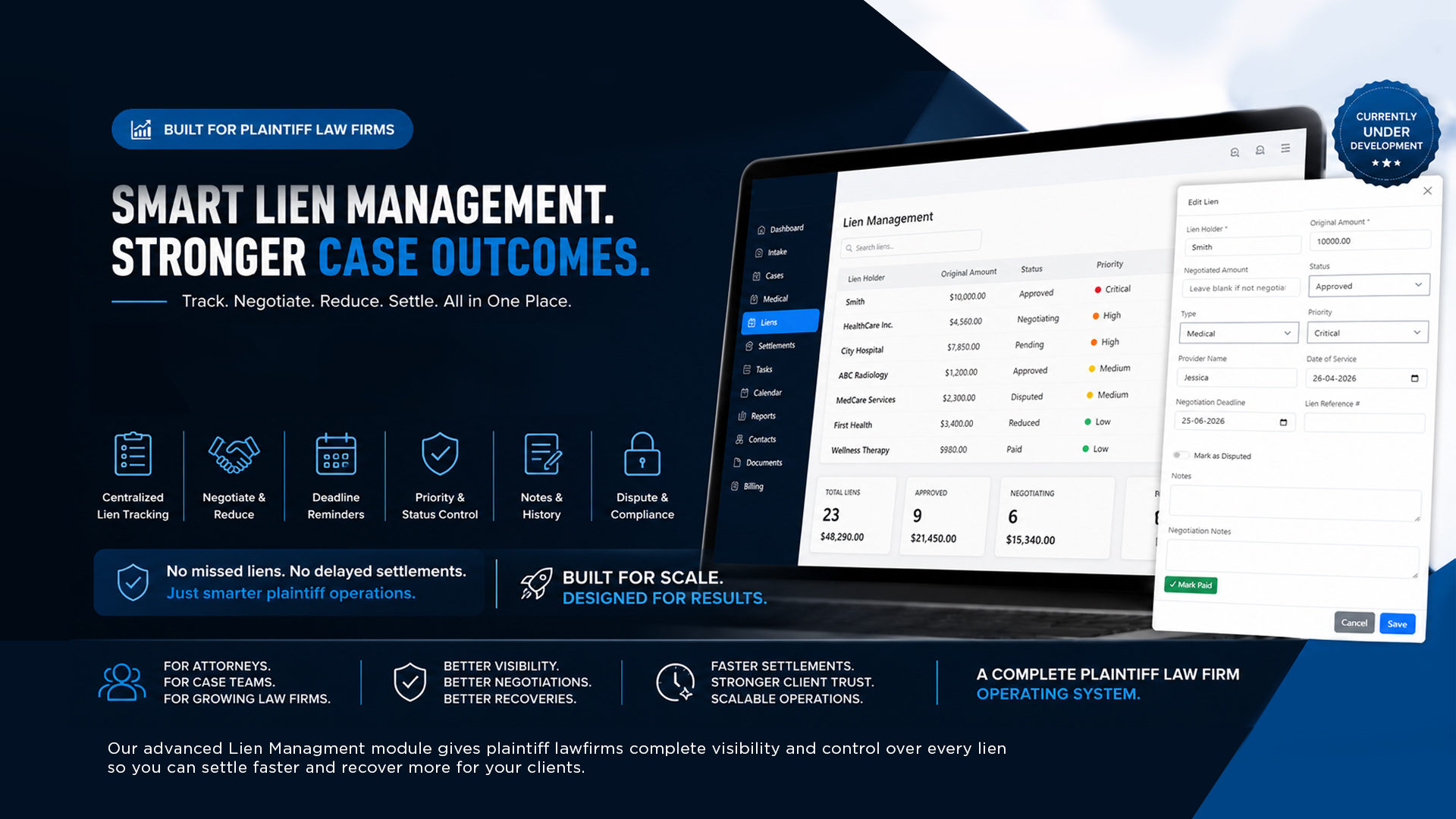
At Canvas Chrome Designs, we are currently developing a next generation Plaintiff Legal Operating System that includes an advanced Lien Management & Tracking Module designed specifically for plaintiff attorneys, settlement teams, negotiators, and case managers.
The goal is simple:
Give plaintiff firms full visibility and control over every lien connected to a case before it becomes a financial or operational problem.
In many firms, liens are still tracked manually.
A typical workflow often looks like this:
Medical bills arrive through email or fax
Staff enters partial information into spreadsheets
Negotiation notes are scattered across emails
Providers follow up repeatedly
Settlement teams manually calculate reductions
Attorneys lack a centralized negotiation history
Deadlines are missed
Paid liens are difficult to audit later
As case volume increases, this becomes extremely difficult to scale.
Even mid sized firms handling hundreds of active injury matters face:
Delayed settlement disbursement
Missing provider documentation
Duplicate payments
Poor visibility into lien priority
Confusion around negotiated reductions
Inconsistent communication between departments
A serious plaintiff litigation system needs more than just “notes.”
It needs structured lien intelligence.
That means:
Every lien attached to a case should live in one organized system.
Including:
Lien holder
Original amount
Negotiated amount
Priority level
Provider details
Service dates
Negotiation deadlines
Reference numbers
Status tracking
Dispute markers
Payment confirmation
Internal negotiation notes
The lien management module we are developing is designed around actual plaintiff firm operations.
Instead of generic CRM fields, the system is structured for legal financial workflows.
Example features include:
Track liens through stages such as:
Pending
Under Review
Negotiating
Approved
Disputed
Reduced
Paid
Closed
This creates visibility for attorneys, settlement managers, and accounting teams simultaneously.
Not all liens carry equal urgency.
The system allows firms to classify:
Critical liens
Medical liens
Insurance liens
Government liens
Hospital balances
Provider collections
This helps legal teams prioritize negotiations before settlement distribution begins.
One of the biggest operational gaps in many plaintiff firms is negotiation documentation.
Our system is being designed to maintain:
Negotiation notes
Reduction requests
Deadline reminders
Provider communication logs
Approval records
Settlement adjustments
This creates a defensible audit trail for every financial decision.
Settlement delays often happen after the case is technically “won.”
The actual bottleneck becomes:
lien verification,
payoff calculation,
reduction approval,
and provider coordination.
Without a structured workflow, firms lose time in the final stage where speed matters most.
A proper lien management system helps firms:
Close settlements faster
Reduce administrative overhead
Improve recovery clarity
Avoid missed obligations
Improve client communication
Increase operational scalability
The plaintiff legal industry is evolving rapidly.
Firms are increasingly adopting:
workflow automation,
centralized dashboards,
financial tracking systems,
AI assisted case operations,
and structured operational software.
Lien management is becoming one of the most overlooked but highest impact areas for operational modernization.
The firms that solve this early will scale faster and operate more efficiently than competitors still relying on fragmented manual processes.
Most legal CRMs stop at:
tasks,
notes,
and document uploads.
But plaintiff firms need operational systems designed specifically around:
settlements,
negotiations,
medical recovery,
provider coordination,
and financial disbursement workflows.
That is the direction our Plaintiff App is being built toward.
Not just a legal CRM.
A complete Plaintiff Law Firm Operating System.
The Plaintiff App is currently under active development with modules focused on:
Intake & Pre Case
Case Management
Medical Tracking
Lien Management
Settlement Timeline Tracking
Billing & Financial Operations
Client Portal
Workflow Automation
Reporting & Analytics
Role Based Access Systems
The vision is to help plaintiff firms move from fragmented operations to structured digital workflows built for scale.
Lien management may not be the most visible part of a plaintiff case.
But operationally, it is one of the most critical.
The firms that build better lien visibility, negotiation workflows, and financial tracking systems will gain:
faster settlements,
stronger operational control,
reduced internal chaos,
and better client experiences.
For growing plaintiff firms, structured lien management is no longer optional.
It is infrastructure.
Canvas Chrome Designs is currently developing enterprise grade operational systems for plaintiff law firms focused on workflow efficiency, scalability, and modern legal operations.
If your firm is exploring digital transformation for plaintiff operations, settlement workflows, or lien management systems, connect with us to discuss future ready legal infrastructure.
No comments yet. Be the first to comment!






Leave A Reply