


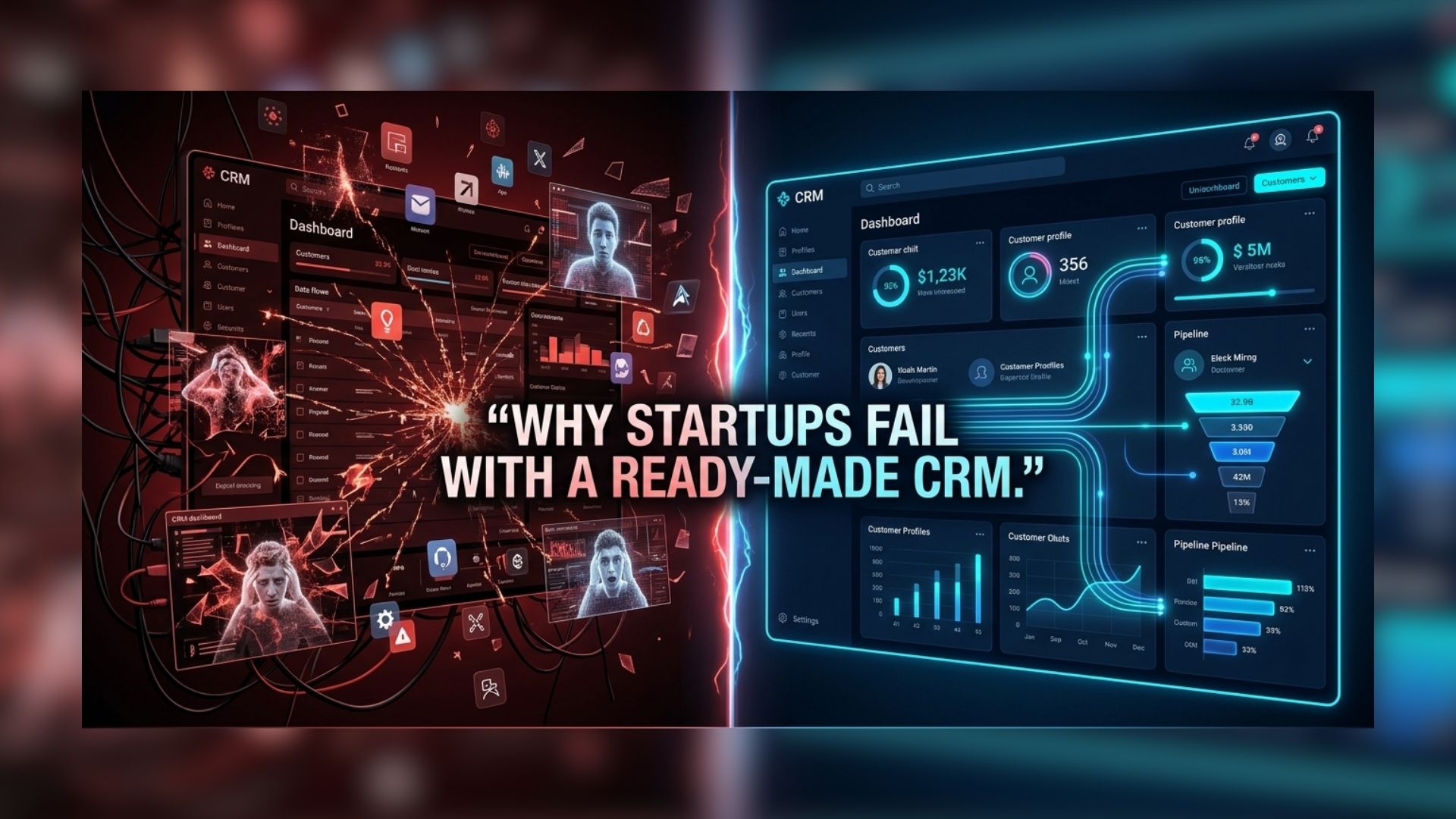
They Fail Because Their Systems Break
A startup can have a strong product, a capable team, and even early traction. Yet many still hit a wall.
Not because demand disappears.
Not because funding dries up.
But because their internal systems cannot handle growth.
And one of the biggest hidden culprits is the CRM.
Most startups begin with popular ready-made tools like Zoho CRM, HubSpot, or Salesforce. These platforms promise quick setup, ease of use, and affordability.
In the early stage, they work.
But as the business grows, these same tools often become the exact reason growth slows down or collapses.
A ready-made CRM is a pre-built software designed for mass usage across industries. It comes with standardized workflows, fixed modules, and limited customization.
They are built for convenience, not for your specific business logic.
That difference becomes critical as soon as your startup starts scaling.
Ready-made CRMs are designed to serve thousands of businesses. That means your startup has to adjust its workflow to fit the software.
Instead of supporting your process, the system forces you into generic pipelines, slowing down efficiency and decision-making.
At 10 clients, everything feels smooth.
At 100, cracks begin to appear.
At 500, the system becomes difficult to manage.
As your startup grows, you start adding:
More pipelines
More automation
More team members
The CRM becomes cluttered, slow, and increasingly complex to operate.
Most startups choose ready-made CRMs because they seem affordable.
But the real cost shows up later:
Per-user pricing increases as your team grows
Add-ons for basic features
Integration costs with other tools
Premium automation limits
What starts cheap becomes expensive very quickly.
To compensate for missing features, startups rely on tools like Zapier and Slack.
This creates a fragile ecosystem where multiple tools depend on each other.
One failure or delay can break entire workflows, affecting sales, operations, and customer experience.
This is where the real damage happens.
Instead of building processes that suit your business, your team starts adjusting operations to fit CRM limitations.
This leads to:
Inefficient workflows
Data inconsistencies
Poor reporting accuracy
Lost opportunities
Over time, your CRM stops being a growth tool and becomes a bottleneck.
Consider a SaaS startup that begins with HubSpot.
At the early stage:
Simple pipeline
Small team
Limited data
Everything works perfectly.
As the startup grows:
Multiple sales funnels emerge
Customer lifecycle becomes complex
Automation requirements increase
The team starts adding integrations, custom fields, and workarounds.
Eventually:
Reporting becomes unreliable
Processes slow down
Teams lose visibility
At this stage, the startup faces a difficult choice:
Rebuild their CRM system or accept slowed growth.
To be clear, ready-made CRMs are not useless.
They work well when:
You are in the early stage
Your sales process is simple
Your team size is small
You need quick deployment
But they are not designed for long-term scalability.
You should seriously consider a custom CRM when:
Your workflows are becoming complex
You are managing multiple teams or departments
Automation is critical for operations
You need deeper data insights
Your current CRM feels limiting instead of enabling
At this stage, continuing with a ready-made CRM can slow down your growth significantly.
A custom CRM is not just software.
It is a system designed specifically for:
Your workflows
Your team structure
Your customer journey
Your growth strategy
Instead of forcing your business to adapt, it adapts to you.
This results in:
Higher efficiency
Better automation
Accurate reporting
Scalable operations
Most startups don’t realize their CRM is the problem until it’s too late.
If your system is creating friction instead of removing it, you are already losing growth opportunities.
At Canvas Chrome Designs, we build custom CRM systems tailored to your exact business model, not generic templates.
👉 Whether you're scaling your startup or fixing an existing system, we help you create a CRM that actually drives growth.
No comments yet. Be the first to comment!





Leave A Reply