


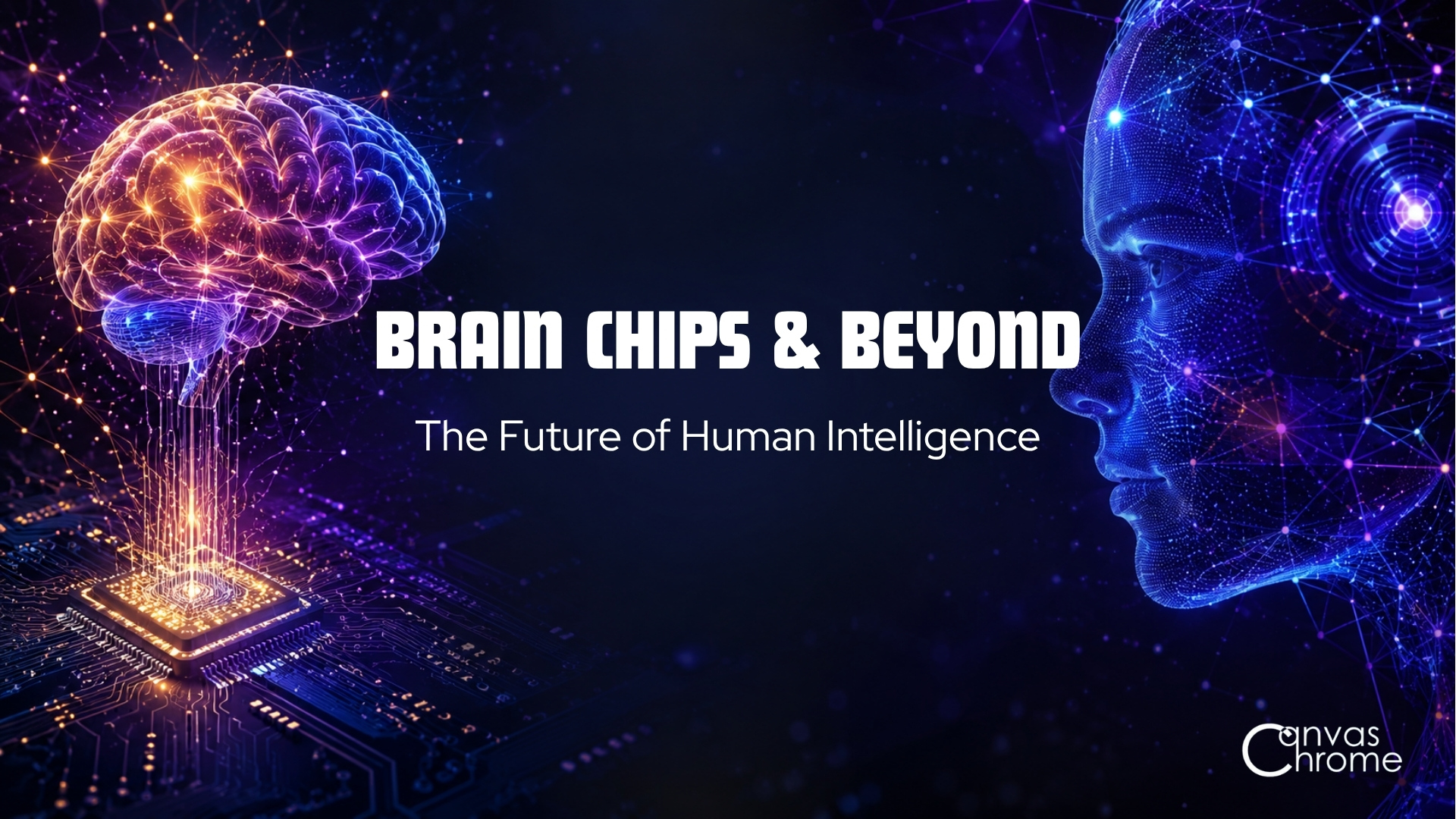
For decades, the idea of connecting the human brain directly to computers belonged to science fiction. Movies, books, and futurists imagined a world where humans could communicate with machines using nothing but thoughts.
That future is no longer imaginary.
Brain chips and brain-computer interfaces (BCIs) are rapidly emerging as one of the most revolutionary technologies of the 21st century. Companies, research institutions, and scientists are working to develop systems capable of translating brain activity into digital commands, potentially changing how humans interact with technology forever.
From restoring mobility in paralyzed patients to enhancing memory and enabling direct communication between the human brain and artificial intelligence, brain chips may represent the beginning of the next era of human intelligence.
As neurotechnology advances, the question is no longer whether brain-machine interfaces are possible.
The question is:
How far can human intelligence evolve when biology and technology become interconnected?
Brain chips are tiny electronic devices implanted into or connected with the brain to record, interpret, or stimulate neural activity.
These devices form the foundation of a broader field called Brain-Computer Interface (BCI) technology.
A brain-computer interface creates a direct communication channel between the human brain and external devices, allowing neural signals to control computers, robotic limbs, or digital systems.
Modern brain chips consist of:
Electrodes that detect neural signals
Processors that interpret brain activity
Wireless communication systems
AI algorithms that decode thoughts into actions
Unlike conventional interfaces such as keyboards or touchscreens, BCIs allow interaction through neural activity itself.
In simple terms:
Brain chips aim to transform thoughts into digital commands.
Brain-computer interface research has existed for decades, but recent breakthroughs in artificial intelligence, machine learning, and neural engineering have accelerated progress dramatically.
Several organizations are pushing the boundaries of neurotechnology, including:
Neuralink
Synchron
Blackrock Neurotech
Precision Neuroscience
Academic institutions worldwide
These organizations are exploring how neural implants can help people suffering from:
Paralysis
Spinal cord injuries
ALS
Parkinson's disease
Epilepsy
Communication disorders
For many patients, BCIs offer hope for restoring independence and improving quality of life.
The human brain contains approximately 86 billion neurons communicating through electrical impulses.
Brain chips capture these signals and translate them into meaningful outputs.
The process generally involves:
Electrodes record electrical activity generated by neurons.
Artificial intelligence algorithms analyze and interpret the neural signals.
Decoded information is transformed into actions such as:
Moving a cursor
Operating robotic limbs
Typing messages
Controlling external devices
Some advanced systems also stimulate neural pathways, creating two-way communication between humans and machines.
This fusion of neuroscience and AI represents one of the most advanced forms of human-machine interaction ever developed.
While medical applications remain the primary focus, experts believe brain chips could eventually reshape many aspects of society.
Future neural implants may help improve:
Memory retention
Learning speed
Concentration
Problem-solving abilities
Scientists are exploring whether brain augmentation could increase human cognitive capabilities beyond natural biological limits.
Instead of typing prompts, future users may communicate with AI systems through thoughts alone.
Such integration could dramatically change:
Search engines
Productivity tools
Education
Digital assistants
Brain-computer interfaces may enable people to communicate directly without speaking or typing.
This could revolutionize accessibility for individuals with speech impairments.
Immersive gaming experiences controlled by thoughts could create entirely new forms of digital entertainment.
Advanced prosthetic limbs controlled through neural signals are already demonstrating remarkable progress.
Artificial intelligence plays a crucial role in the success of brain-computer interfaces.
Raw neural signals are extremely complex.
Machine learning algorithms help:
Decode patterns in brain activity
Translate intentions into commands
Improve accuracy over time
Personalize neural responses
As AI models become more powerful, brain chips may become increasingly capable and responsive.
Some futurists envision a world where humans and AI systems operate in close collaboration, creating a new form of augmented intelligence.
This concept is often referred to as human-AI symbiosis.
Despite their promise, brain chips raise significant ethical questions.
If devices can read neural signals, how should personal thoughts be protected?
Could brain implants become vulnerable to hacking or malicious interference?
Would cognitive enhancement technologies only be available to wealthy individuals?
As technology merges with biology, society may need to redefine what it means to be human.
These concerns are driving ongoing debates among scientists, ethicists, governments, and technology companies.
Several obstacles remain before brain chips become mainstream.
The human brain is extraordinarily complex, making accurate signal interpretation difficult.
Long-term implantation raises concerns regarding:
Tissue damage
Infection
Device durability
Medical and ethical standards require extensive testing before widespread adoption.
Advanced neurotechnology remains expensive and inaccessible to most people.
Overcoming these challenges will require decades of research and collaboration across multiple disciplines.
Perhaps the most fascinating possibility involves cognitive augmentation.
Some experts believe future brain-machine interfaces could eventually enhance:
Memory
Intelligence
Creativity
Multitasking
Knowledge access
Rather than replacing humans, AI-powered neural interfaces may expand human capabilities.
This could represent the emergence of a new era known as augmented intelligence, where technology enhances rather than competes with human cognition.
Whether such capabilities become reality remains uncertain, but the pace of innovation suggests that extraordinary changes may lie ahead.
Brain chips are more than medical devices.
They represent the convergence of:
Artificial intelligence
Neuroscience
Biotechnology
Robotics
Human enhancement
As these fields continue to evolve, humanity may enter an age where intelligence itself becomes programmable, expandable, and deeply interconnected with machines.
What once seemed impossible is steadily becoming scientifically achievable.
The next revolution may not happen on our screens.
It may happen inside our minds.
Brain chips and brain-computer interfaces are ushering in a new frontier where biology and technology converge.
From restoring lost abilities to potentially enhancing human cognition, neurotechnology could transform healthcare, communication, education, and the relationship between humans and artificial intelligence.
Although significant ethical and technical challenges remain, one thing is becoming increasingly clear:
The next era of human intelligence may not be defined solely by what humans know, but by how humans and machines learn to think together.
No comments yet. Be the first to comment!










Leave A Reply