


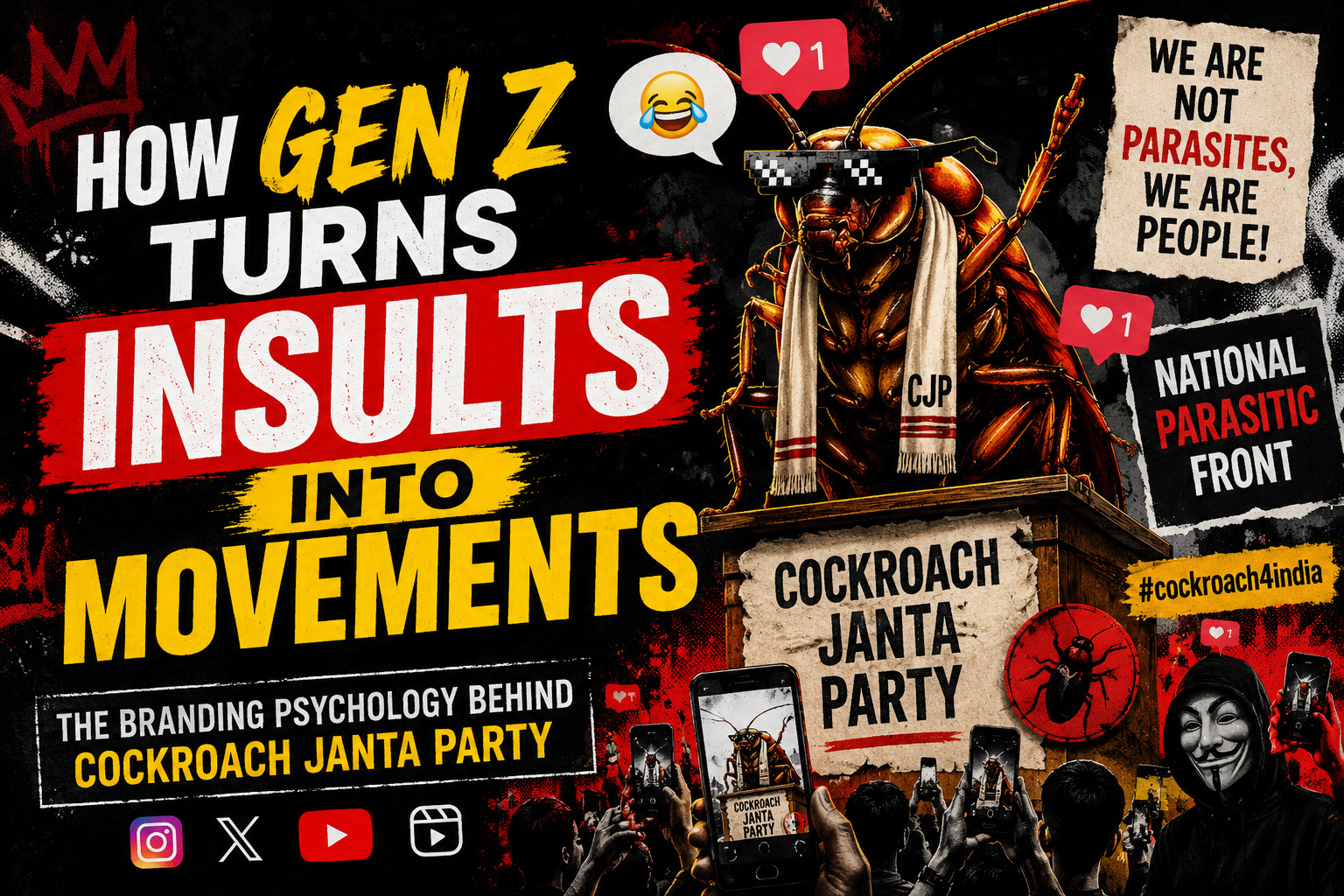
The internet no longer reacts to insults the way previous generations did.
Gen Z does something entirely different.
They absorb the insult, remix it into humor, transform it into identity, and weaponize it through virality.
That is exactly what happened with the sudden rise of “Cockroach Janta Party” and related meme movements like “National Parasitic Front” and “cockroach4india.” What started as a controversial public comparison quickly evolved into one of the most unexpected examples of digital-first political satire in India.
But beneath the memes, edits, reels, and ironic slogans lies something deeper.
This is not just about jokes.
This is about branding psychology.
This is about how younger internet audiences convert humiliation into collective belonging.
And more importantly, it reveals how modern movements are no longer built through ideology first. They are built through emotion, symbolism, relatability, and algorithmic momentum.
Earlier generations treated labels as fixed reputational attacks.
Gen Z treats labels as editable content.
This shift is extremely important.
On platforms like Instagram, X, Reddit, and TikTok-style short video ecosystems, identity itself has become participatory. The audience no longer consumes narratives passively. They manipulate them.
When an insult becomes public, Gen Z often follows a predictable pattern:
Screenshot the moment
Turn it into a meme
Remove its original power
Repackage it as irony
Build a community around shared frustration
Amplify it using humor and repetition
This process neutralizes shame.
In branding psychology, this is called “symbolic reclamation.”
Historically, subcultures have always reclaimed insults. But social media dramatically accelerated the speed and scale of that transformation.
What once took years now happens in hours.
Most viral movements fail because they try too hard to appear serious.
Cockroach Janta Party succeeded because it embraced absurdity.
The name itself sounds intentionally ridiculous, which immediately makes it memorable. In branding terms, memorability is one of the strongest growth accelerators in crowded attention economies.
Several psychological triggers contributed to its spread:
A large section of young audiences already feels:
economically uncertain
professionally ignored
politically disconnected
socially unheard
The meme became an emotional outlet.
Not because people literally identified as “cockroaches,” but because the symbolism represented alienation.
Humor is one of the strongest tools for social participation.
People hesitate to join ideological debates.
They do not hesitate to share memes.
Comedy lowers psychological resistance.
That is why satire spreads faster than policy discussions.
Modern internet communities thrive on layered irony.
Many participants are intentionally ambiguous:
Are they serious?
Are they joking?
Are they protesting?
Are they trolling?
The answer is often all four simultaneously.
This ambiguity increases engagement because audiences continuously interpret and reinterpret the movement.
The movement’s graphics, symbols, edits, and parody-style political aesthetics are highly shareable.
Strong meme branding usually contains:
low design complexity
high emotional recognition
instantly understandable symbolism
remix potential
This is exactly why meme pages exploded around the topic.
Traditional political branding relies on:
manifestos
speeches
ideological positioning
media coverage
Internet-native branding works differently.
Modern digital movements are often built around:
emotional resonance
aesthetic consistency
meme repeatability
identity participation
algorithm compatibility
The audience is not just consuming the movement.
They are co-creating it.
That changes everything.
Every repost becomes free marketing.
Every meme becomes distributed branding.
Every comment becomes narrative expansion.
This is the same psychological mechanism that powers:
fandom cultures
online gaming communities
crypto meme ecosystems
creator fandoms
viral internet trends
The difference is that political satire is now entering the same infrastructure.
Many younger audiences no longer trust institutional communication.
Formal speeches feel scripted.
Corporate messaging feels artificial.
Traditional politics feels distant.
But memes feel native to their environment.
Satire gives Gen Z three things simultaneously:
emotional release
social belonging
plausible deniability
That last point matters.
Humor allows participation without full ideological commitment.
A user can share a meme and later claim:
“It was just a joke.”
This flexibility massively increases participation rates online.
Social media algorithms are not optimized for truth.
They are optimized for engagement.
And engagement thrives on:
outrage
humor
surprise
identity conflict
repetition
emotional relatability
Cockroach Janta Party contains nearly all of these ingredients.
It is:
controversial
funny
symbolic
emotionally charged
visually adaptable
culturally unexpected
That combination is algorithmically powerful.
Businesses often underestimate internet culture.
That is a mistake.
Modern branding is no longer controlled entirely by companies. Communities now shape narratives faster than brands themselves.
The rise of meme-driven movements reveals several important lessons:
People connect more deeply with emotionally authentic communication than perfect corporate language.
Audiences no longer want to remain passive consumers.
They want to remix, react, comment, parody, and contribute.
Overdesigned campaigns often fail online.
Simple symbolic communication spreads faster.
Many brands still treat humor as optional.
In reality, humor has become one of the strongest attention-retention tools in digital ecosystems.
Despite its virality, meme-driven activism also carries risks.
Movements built primarily on irony can struggle with:
long-term direction
ideological consistency
leadership structure
accountability
misinformation
narrative fragmentation
Virality alone does not guarantee sustainability.
Internet attention moves quickly.
What trends today may disappear tomorrow.
The challenge for any digital movement is converting attention into meaningful structure.
Very few succeed.
Cockroach Janta Party may eventually fade as a meme trend.
But the larger phenomenon will not disappear.
This represents a broader transformation in how younger generations communicate politically online.
Future digital movements will increasingly rely on:
meme ecosystems
short-form video culture
participatory branding
symbolic humor
decentralized storytelling
The internet has fundamentally changed how collective identity forms.
Movements are no longer built only through rallies and speeches.
They are now built through reels, edits, memes, comments, and viral symbols.
That shift is permanent.
Whether one sees Cockroach Janta Party as satire, protest, performance art, or algorithmic chaos, its rapid rise reveals something undeniable about modern internet culture.
Gen Z understands attention better than institutions do.
They know that in digital ecosystems:
irony spreads faster than seriousness
memes travel faster than manifestos
humor creates participation
identity drives virality
Most importantly, they understand that in the age of algorithms, even an insult can become a movement if enough people emotionally relate to it.
And that may be the most important branding lesson of all.
No comments yet. Be the first to comment!




Leave A Reply