



Critical PHP Security Vulnerabilities: What Website Owners Must Do Now
The PHP development team has released urgent security updates addressing two critical vulnerabilities that could allow attackers to execute malicious code on vulnerable web servers without authentication. Announced on October 21, 2026, these flaws have prompted cybersecurity agencies to recommend immediate action for organisations running PHP-powered websites and applications.
PHP is widely used to build business websites, ecommerce platforms, content management systems, and enterprise applications. Frameworks such as Laravel also rely on PHP to execute backend operations. Consequently, vulnerabilities within the PHP runtime can create security risks that extend beyond individual applications.
For website owners, businesses, developers, and IT administrators, understanding this security update is essential to protecting online services and sensitive information.
What Are the Newly Discovered PHP Security Vulnerabilities?
The October 2026 security release addresses two vulnerabilities identified as CVE-2026-109618 and CVE-2026-109619. Both are associated with memory-handling issues within PHP and can potentially enable remote code execution on vulnerable systems.
Remote code execution is a serious security risk because it may allow an attacker to run unauthorised commands on a compromised server. Depending on the server's permissions and configuration, a successful attack could affect application files, expose sensitive information, or compromise connected services.
The vulnerabilities involve different technical issues:
CVE-2026-109618: Out-of-Memory Handling
This vulnerability involves PHP's handling of memory allocation failures. Under certain conditions, partially initialised internal request data may be processed incorrectly during cleanup, potentially creating an opportunity for malicious code execution.
CVE-2026-109619: Stale Internal Global State
The second vulnerability involves internal state that may remain accessible after its underlying memory has been released. Improper handling of this state can create another potential route to remote code execution.
These are PHP runtime vulnerabilities, not simply application-level coding mistakes. A website may therefore be exposed even if its developers have followed secure coding practices.
Which PHP Versions Are Affected?
The PHP team released patched versions on October 21, 2026. The official security announcement identifies the following releases as fixes for both vulnerabilities.
PHP Branch Security Update
PHP 8.5 8.5.12
PHP 8.4 8.4.27
PHP 8.3 8.3.36
PHP 8.2 8.2.35
If your website runs an earlier version in one of these branches, check your hosting provider's security updates and upgrade to the appropriate patched release.
Important: PHP 8.2 reaches the end of its upstream security support on December 31, 2026. Businesses still using this branch should also plan a migration to a currently supported PHP version.
Organisations running older PHP branches should consult their operating system vendor or hosting provider to determine whether a supported security patch is available. Do not assume that an older installation is protected simply because it is not listed in the latest release table.
How Can These Vulnerabilities Affect Business Websites?
A compromised website can create financial, operational, and reputational problems. The potential impact depends on the attack, server configuration, permissions, and the data accessible to the affected application.
Key risks include:
Website compromise: Attackers may gain the ability to execute unauthorised commands on vulnerable servers.
Sensitive data exposure: Database credentials, customer records, authentication tokens, and other information may be at risk.
Business disruption: A security incident may require taking services offline while investigating and restoring systems.
Application integrity issues: Malicious changes to application files or configurations may affect normal website operations.
Customer trust and compliance concerns: A security incident involving personal or business information may trigger contractual, regulatory, or notification obligations.
Not every vulnerable server will experience a successful attack. However, the potential severity makes prompt remediation important.
What Should Website Owners Do Immediately?
Businesses should treat this announcement as a priority for their website maintenance and security teams.
1. Check the PHP Runtime Version
Identify the PHP version used by the actual web application. Running php -v in a terminal is a useful first step, but command-line PHP may differ from the version configured for the website.
Check PHP-FPM, Apache, hosting control panel settings, containers, and other relevant runtime configurations.
2. Install the Appropriate Security Update
Upgrade to the applicable patched PHP release or install a verified security package supplied by your operating system or hosting provider.
PHP's official advisory states that updating is the only complete solution. Configuration changes alone should not be treated as a substitute for patching.
3. Restart Relevant Services
After upgrading, restart the appropriate PHP-FPM, Apache, or other PHP-serving processes so they load the updated runtime.
Long-running PHP workers may also need to be restarted. Confirm the version actually serving web requests rather than relying exclusively on the package installation status.
4. Test Your Website and Applications
Run functional checks after the update. Test authentication, forms, database connectivity, file uploads, payment workflows, scheduled jobs, queues, and important integrations.
For Laravel applications, review application logs and verify that critical features continue working correctly.
5. Review Security Logs
Inspect relevant web server, application, and system logs for unusual requests, unexpected errors, suspicious file changes, or unexplained process activity.
If compromise is suspected, preserve relevant evidence and initiate an incident-response process. Patching prevents continued exposure to the known vulnerabilities but does not establish whether a server was previously compromised.
6. Verify Backups and Access Controls
Maintain recent backups and verify that restoration works. Review administrative access, file permissions, exposed services, and the credentials available to application processes.
Where a compromise is confirmed, rotate affected credentials and investigate the potential exposure of database passwords, API keys, and other secrets.
What Does This Mean for Laravel Developers?
Laravel developers should distinguish between application security and runtime security.
Updating Laravel dependencies does not automatically patch a vulnerable PHP installation. The PHP interpreter must be updated independently, although the overall maintenance process should also include checking framework dependencies and other server components.
Before deploying a PHP runtime update to production, developers should:
Verify PHP and extension compatibility.
Review the application's dependency requirements.
Test the application in staging.
Confirm that the production runtime uses the patched version.
Restart the relevant services and workers.
Monitor logs and application behaviour after deployment.
For applications hosted on virtual private servers, teams should also check whether multiple websites use different PHP versions or separate PHP-FPM pools. Updating one installation may not protect every application on the server.
Why Regular Website Maintenance Matters
Security updates are a fundamental part of operating a reliable business website. Even well-designed applications depend on their programming languages, frameworks, libraries, operating systems, and hosting environments remaining secure.
A proactive website maintenance strategy should include routine patch management, automated backups, access-control reviews, dependency updates, monitoring, and periodic security assessments.
Businesses using custom Laravel applications, ecommerce platforms, customer portals, or other PHP-based systems should maintain an inventory of their applications and runtime versions. This makes it easier to identify affected systems and prioritise security updates when new vulnerabilities are announced.
How Canvas Chrome Designs Helps Businesses Maintain Secure Digital Platforms
At Canvas Chrome Designs, we provide website design and development, custom software development, ecommerce solutions, and technology consulting for businesses looking to build and maintain dependable digital platforms.
Our development approach considers application functionality, performance, maintainability, and security throughout the project lifecycle. This includes reviewing technical requirements, evaluating dependencies, testing important workflows, and planning appropriate maintenance activities.
Whether you operate a business website, an ecommerce platform, or a custom Laravel application, keeping your technology stack updated is an important part of protecting your digital investment.
Need help reviewing your website's technology stack or planning a maintenance strategy? Contact Canvas Chrome Designs to discuss your website development and technical requirements.
Final Thoughts
The October 2026 PHP security releases highlight an important principle of website security: protecting an application requires maintaining its underlying technology, not just its application code.
Businesses should identify affected PHP installations, install the appropriate security updates, restart relevant services, and verify that their applications are operating correctly. A structured approach to patch management and ongoing maintenance can reduce avoidable security risks and help keep business-critical websites reliable.
Official reference: Review the latest advisories and release information on the PHP official security announcements page - https://www.php.net/archive/2026.php?trk=public_post_comment-text&utm_source=chatgpt.com
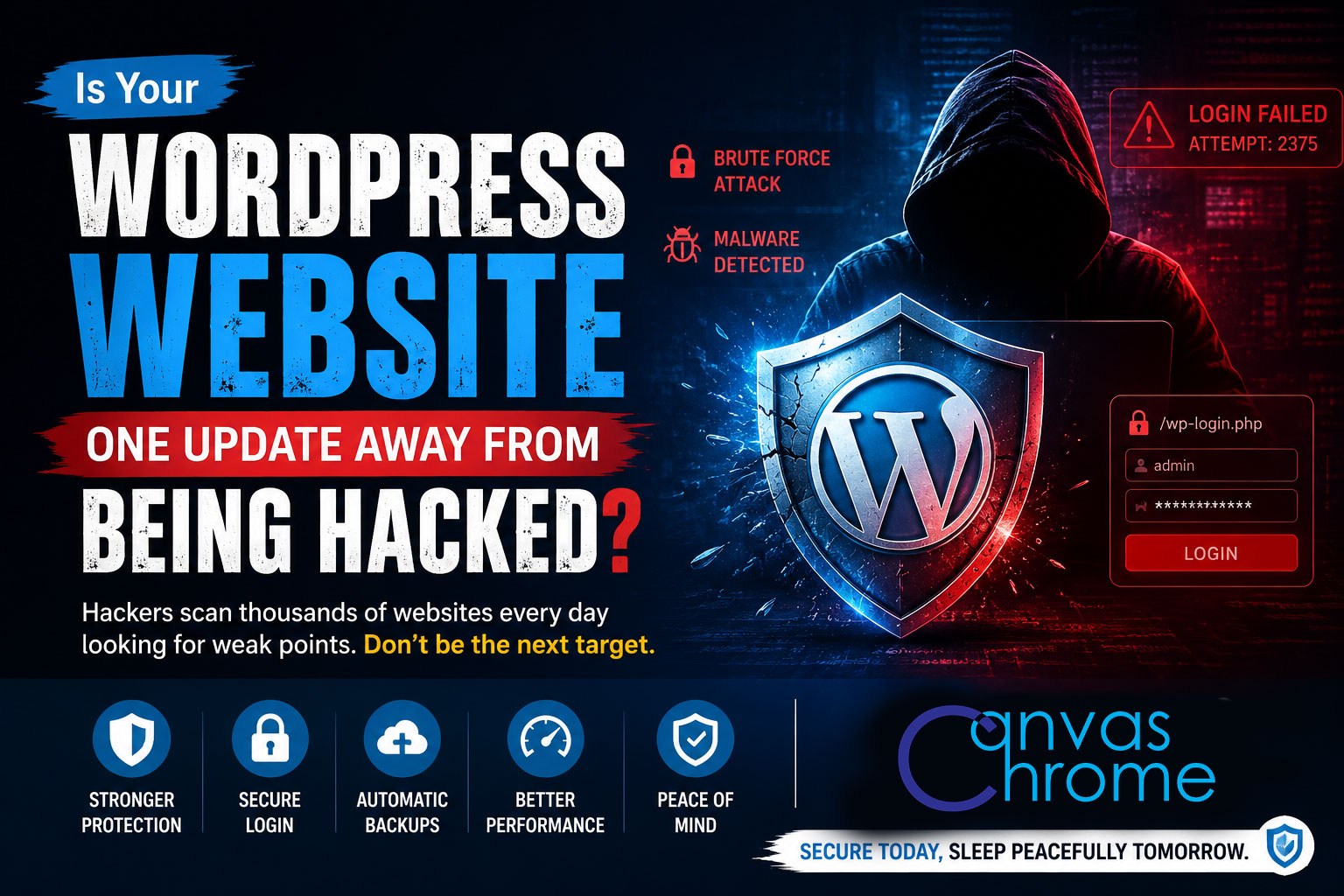
PHP security vulnerabilities and server protection measures announced in October 2026.
No comments yet. Be the first to comment!







Leave A Reply